
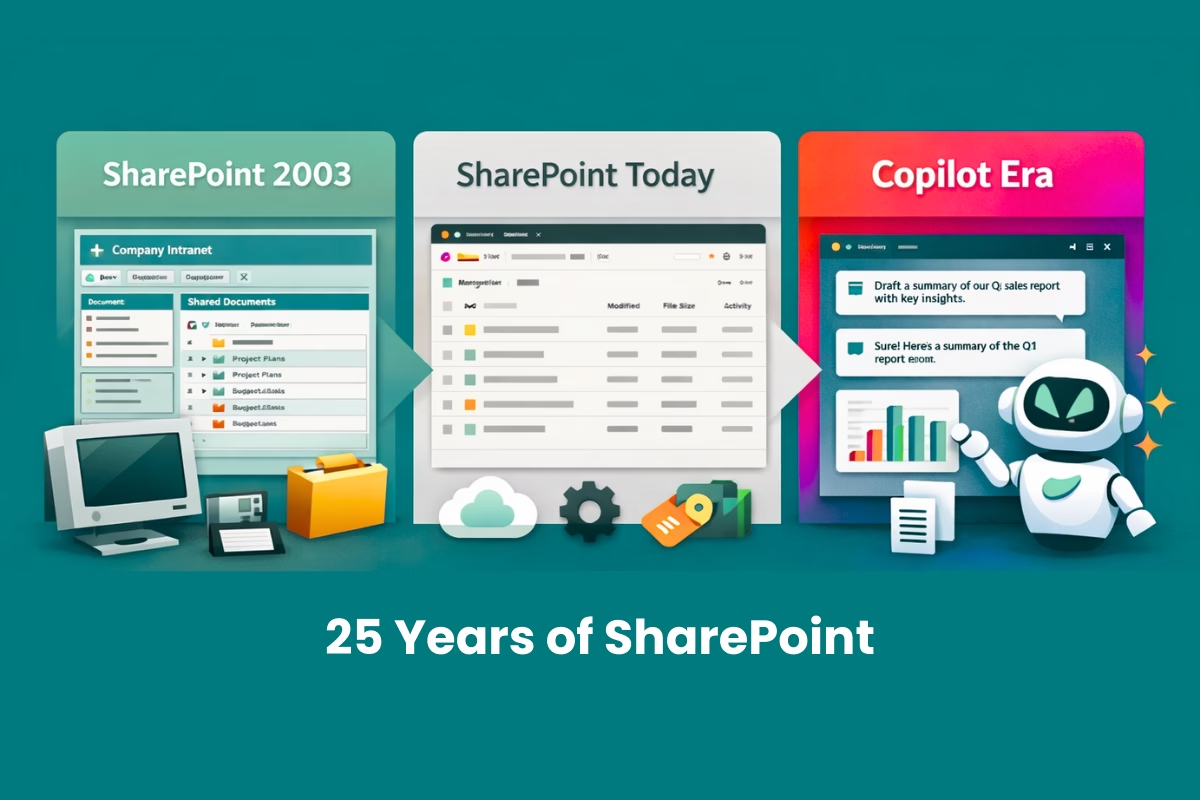
Most people don’t choose SharePoint as a career. They end up there… and then never quite leave.
My SharePoint journey started back in 2003 during what was meant to be a short, very unremarkable three-month maternity leave cover role as an executive assistant. I was there to keep a seat warm, answer phones, and stay out of trouble. Instead, I discovered SharePoint.
Not in a “this is amazing” way — more in a “this could be dangerous in the wrong hands” way.
I started tinkering, then building, then asking why things were done the way they were. Before anyone really noticed, I’d built and launched an intranet for a global company and accidentally created a career for myself. That three months turned into 13 years with the same organisation, countless migrations, and a steady evolution from “the SharePoint person” to consultant.
Fast forward 25 years, and I’m still here — fixing broken environments, untangling permissions, designing information architecture, and explaining (again) why folders alone are not a strategy. It hasn’t always been pretty, but it has been endlessly interesting. Somehow, after all this time, I still enjoy getting my hands dirty and making SharePoint actually work the way people need it to.
The Horror Stories We All Share
If you’ve worked with SharePoint for any length of time, you don’t need me to explain the pain. You’ve lived it.
The inherited environment no one wants to own. The migration where everything was “lifted and shifted” and quietly made worse. The permissions model that looks like it was designed by a committee of ghosts.
And then there were subsites.
At the time, they felt like a good idea — logical, neat, sensible. In reality, they became a sprawling underground city of broken inheritance, mystery navigation, and content no one dared touch. We’ve moved on to hubs now, which is progress, but it hasn’t stopped the real problem: uncontrolled growth with no agreed structure.
Which brings us to governance — or more accurately, the absence of it.
In many organisations, governance still exists as a PDF created during a project, signed off, uploaded to SharePoint, and never referenced again. Meanwhile, sites multiply, folders deepen, metadata drifts, and permissions quietly unravel.
And yes, the folder debate still rages on.
People cling to folders because they’re familiar and feel safe. Metadata scares people, not because it’s difficult, but because it requires decisions. In my experience, the best environments almost always use a hybrid approach — but getting there means changing habits, and that’s where resistance usually shows up.
Over the years, I’ve had plenty of standoffs with people who don’t want to change how they work. My approach is always the same: show them one thing that saves time. One view. One filter. One less click.
That’s usually all it takes.
From Mess to Method: Why SharePoint Still Matters
Despite all of this — or perhaps because of it — I’m more excited about SharePoint now than I’ve ever been.
Modern SharePoint is not the SharePoint of 2003, 2010, or even 2016. The platform has matured significantly, and the new document library experience is genuinely good. Views are finally front and centre, where they always should have been.
More importantly, Microsoft has made its position very clear: SharePoint is the backbone of Microsoft 365 and the foundation for Copilot.
This is where the conversation shifts.
Copilot doesn’t fix a messy environment — it accelerates it.
If your permissions are loose, Copilot will surface sensitive content.
If your metadata is inconsistent, Copilot will give inconsistent answers.
If your structure is unclear, Copilot will confidently return the wrong thing.
There is no AI without Information Architecture.
AI doesn’t need more content. It needs better structure.
Governance stops being a theoretical exercise and becomes a design discipline. When ownership, structure, and lifecycle are built into the environment from the start, everything else becomes easier — search, security, automation, and AI included.
What I’ve Learned After 25 Years
After more than two decades in the trenches, one thing is very clear:
Most SharePoint problems are predictable.
They’re not caused by the platform. They’re caused by:
- No clear structure
- No ownership
- No consistency in how content is created and managed
And yet, organisations keep trying to fix the symptoms instead of the cause.
That’s why everything I create now focuses on simple, practical structure — the kind that actually holds up in real workplaces, not just in theory.
Still Here, Still Fixing
After 25 years, SharePoint has challenged me, frustrated me, and shaped my career in ways I never planned.
I don’t believe SharePoint is broken.
I believe it’s been misunderstood.
If you’ve inherited a mess, are staring down Copilot, or just want your environment to make sense again — you’re not alone.
And yes… it can be fixed.
Where to Go Next
If you’re ready to start sorting things out properly, I’ve pulled together a set of practical guides, checklists and resources to help you do exactly that.
No fluff. No theory. Just what actually works.