I’ve been building SharePoint information architectures for almost 20 years. I’ve seen it all—the 47-level-deep folder structures, the “New Folder (2) – Copy – Final – FINAL” nightmares, the permissions chaos where nobody knows who can see what, and the metadata schemes that made perfect sense to someone in 2015 but are now archaeological mysteries.
And here’s what I’ve learned: You can’t AI your way out of a structural problem.
Don’t get me wrong—AI is transformative. Microsoft Copilot can do remarkable things with your SharePoint content. But only if that content is structured properly in the first place. Copilot can’t fix chaos. It can only amplify it.
So when organizations hire me to “fix the mess” and build a modern SharePoint environment, I don’t start by asking ChatGPT to analyze their files. I start by understanding how their people actually work.
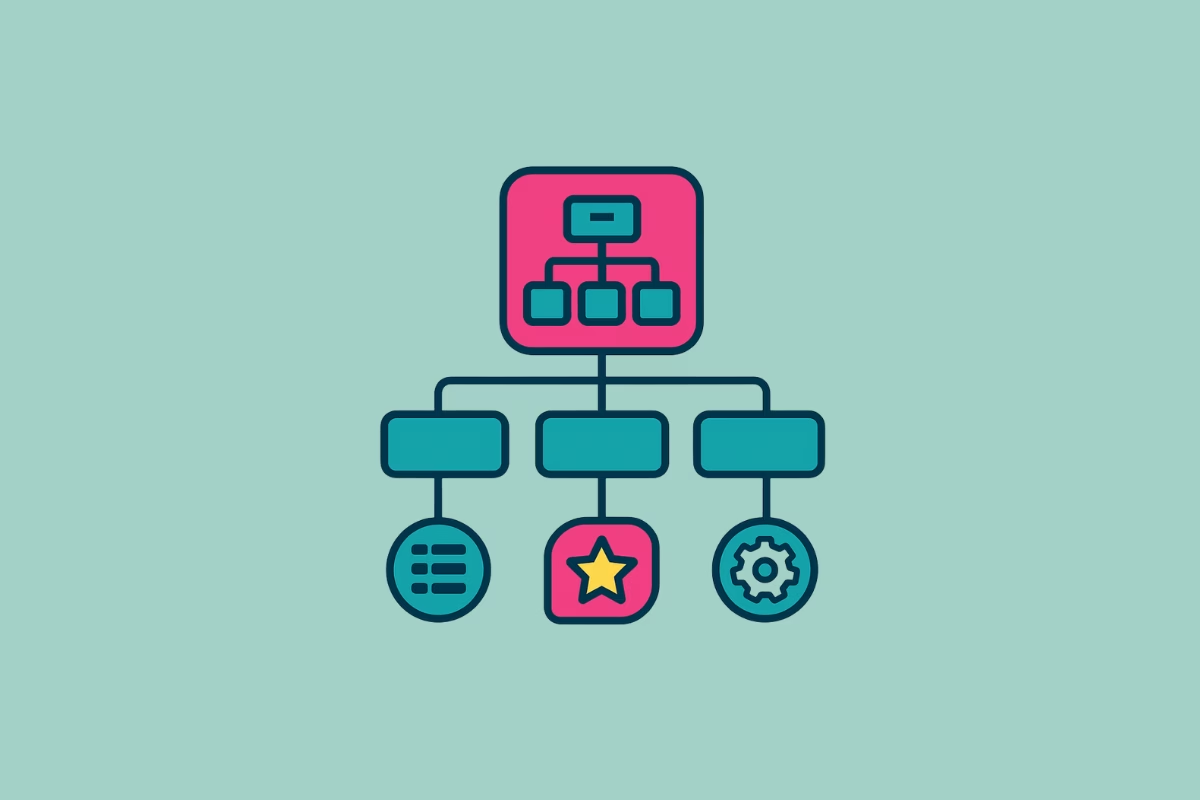
Here’s my battle-tested, five-phase process for transforming chaotic content into intelligent business assets.
Stay Updated
Want more AI-ready SharePoint insights?
Subscribe to my weekly newsletter to get real-world Information Architecture lessons, practical workflows, and step-by-step guidance for building clean, Copilot-ready SharePoint environments.
Subscribe to the Newsletter →You’ll Learn
- • How to structure SharePoint properly
- • Metadata that actually works with AI
- • My 5-phase IA blueprint
- • Real examples from client projects
Phase 1: Discovery — Understanding the Mess Before You Fix It
The first rule of information architecture: Never trust the org chart.
When I begin a SharePoint project, I don’t start in SharePoint. I start by looking at everything that exists—file shares, old SharePoint sites, Teams channels, OneDrive folders, that ancient network drive everyone still uses, and yes, even the occasional Dropbox folder someone set up “just for this one project” three years ago.
What I’m Looking For:
Patterns in the chaos. How do teams actually organize their work? Not how the IT department thinks they should organize it, but how they actually do it in practice.
Permission boundaries. Who works with whom? Where are the natural divisions between departments, projects, or functions? Where do people need to collaborate across silos?
Content types that matter. Every organization has documents that are treated differently. Policies that need approval workflows. Contracts that have retention requirements. Project deliverables that follow a lifecycle. I need to identify these before I start building.
Naming conventions (or lack thereof). Are there patterns in how people name files and folders? Even bad patterns tell me something about how people think about their content.
The Export Process:
I take a complete export of existing content—not to migrate it blindly, but to analyze it. I’m looking at:
- Folder depth and structure
- File naming patterns
- Metadata (if any exists)
- File types and sizes
- Creation and modification dates
- Permission structures
This gives me a map of the current landscape. And more importantly, it shows me where the pain points are.
Phase 2: Analysis — Where Experience Meets Intelligence
This is where AI comes in—but not how you might think.
I don’t hand my export to an AI and ask it to design an information architecture. That’s like asking a calculator to write a business strategy. AI doesn’t understand organizational culture, political dynamics, or how your finance team refuses to collaborate with operations because of that incident in 2019.
What AI Does Well:
Once I’ve already mapped out a potential structure based on my experience and understanding of how the organization works, I use AI to:
Consolidate patterns. If I’ve identified 47 different ways people name project folders, AI can help me group them into logical categories and suggest a unified naming convention.
Analyze content at scale. I can feed AI a sample of documents and ask, “What topics appear most frequently?” or “What metadata would be most useful for categorizing these files?” This validates (or challenges) my initial assumptions.
Identify outliers. AI is excellent at finding the weird stuff—the files that don’t fit any pattern, the folders that are structured completely differently, the content that might need special handling.
What AI Doesn’t Do:
Understand your business. AI doesn’t know that your “Projects” folder should actually be split into “Client Projects” and “Internal Projects” because they have completely different lifecycles and permission requirements.
Make strategic decisions. Should you organize by department, by function, by project, or by a hybrid model? That’s a business decision based on how your teams collaborate, your compliance requirements, and your growth plans. No AI can make that call.
Navigate politics. When the VP of Sales insists that their team needs a completely separate structure because “we’re different,” that’s a conversation that requires human judgment, not an algorithm.
My Analysis Process:
- Map how teams actually work together. Who collaborates with whom? Where are the handoffs? Where do workflows cross departmental boundaries?
- Identify permission boundaries. Where does confidential information live? Who needs access to what? Where are the security and compliance requirements?
- Define content lifecycles. What content is actively worked on? What needs to be archived? What has retention requirements? What can be deleted?
- Determine the hub, site, and library structure. This is the foundation of everything. Get this wrong, and no amount of metadata will save you.
Based on these factors—not on what AI suggests—I design the core information architecture.
Advanced Guide · $297
Ready to implement a professional information architecture?
The SharePoint Information Architecture Guide ($297) gives you the complete framework, templates, and checklists to structure your SharePoint environment like a pro.
- Complete IA framework (strategy to implementation)
- Content type library and metadata templates
- Governance checklists and naming conventions
- Real-world examples from 20+ years of experience
- Copilot-ready structure included
Phase 3: Structure — Building the Foundation
Good information architecture is invisible. Bad information architecture is everywhere.
Once I understand how the organization works and what structure will support their actual workflows (not their theoretical ones), I start building.
Hub, Site, and Library Design:
This is where most SharePoint projects fail. People either:
- Create one massive site with 50 libraries (impossible to navigate)
- Create 200 tiny sites with one library each (impossible to govern)
- Organize by org chart instead of by how work actually flows (impossible to use)
I design structures based on:
Collaboration patterns. If Marketing and Sales work together constantly, they should share a hub. If Finance and HR never interact, they shouldn’t.
Permission requirements. If a group of content needs the same permissions, it should be in the same library. If it needs different permissions, it should be separate.
Workflow boundaries. If content follows a specific approval or review process, that process should map to the structure.
The Container Method™ approach: I think of SharePoint sites as containers that hold related work. Each container has clear boundaries, consistent structure, and a specific purpose. This makes it intuitive for users and scalable for administrators.
Phase 4: Content Types and Metadata — Making Content Intelligent
This is where SharePoint becomes more than just a file share.
Metadata is what makes your content findable, manageable, and AI-ready. But most organizations do metadata wrong. They either:
- Don’t use it at all (chaos)
- Use too much of it (nobody fills it out)
- Use the wrong metadata (doesn’t match how people search)
My Content Type Strategy:
Never edit the out-of-the-box Document content type.
This is critical. SharePoint’s base Document content type is used everywhere. If you modify it, you’ll break things. Instead, I create a custom organizational content type that inherits from Document.
Why this matters: When Microsoft updates SharePoint, they update the base content types. If you’ve modified them, your customizations can break. But if you’ve created child content types, your customizations are protected.
Here’s My Standard Approach:
Step 1: Create a custom organizational content type (e.g., “Contoso Document”) that inherits from the base Document content type.
Step 2: Add any metadata columns that apply to ALL documents in your organization (e.g., Department, Document Status, Retention Category).
Step 3: Create specific content types that inherit from your organizational content type:
- “Contoso Policy” (for policies and procedures)
- “Contoso Contract” (for legal agreements)
- “Contoso Project Deliverable” (for project outputs)
- “Contoso Marketing Asset” (for marketing materials)
Each of these inherits the base organizational metadata and adds its own specific fields.
Why this hierarchy matters:
✅ All documents share common organizational metadata
✅ Specific document types have their own specialized metadata
✅ Changes to the organizational content type cascade to all children
✅ You can add new content types without disrupting existing ones
✅ Microsoft updates don’t break your customizations
My Term Store Strategy:
The term store is where metadata becomes manageable.
Instead of letting users type free text (which leads to “Marketing,” “marketing,” “Mktg,” and “MARKETING” all being different values), I use managed metadata term sets.
Here’s my approach:
Step 1: Create a new term store group called “Information Architecture” (or “[Organization Name] Taxonomy”).
Why? This keeps your organizational metadata completely separate from Microsoft’s out-of-the-box term sets. When you’re troubleshooting or making changes, you can instantly see what’s yours and what’s Microsoft’s.
Step 2: Create term sets for each major metadata category:
- Departments
- Document Types
- Project Status
- Client Names
- Product Lines
- Retention Categories
Step 3: Populate each term set with controlled values.
For example, instead of letting people type department names, they select from:
- Finance
- Human Resources
- Information Technology
- Marketing
- Operations
- Sales
The benefits:
✅ Consistent metadata across all content
✅ Easy to update (change “Marketing” to “Marketing & Communications” in one place, updates everywhere)
✅ Supports multilingual organizations (term sets can have translations)
✅ Makes search and filtering actually work
✅ Gives Copilot clean, structured data to work with
Phase 5: Automation — Metadata Without the Pain
The best metadata is the metadata users don’t have to enter. This is where I combine folders and metadata in a way that makes both camps happy.
The Folder vs. Metadata Debate:
Folder purists say: “Folders are intuitive! Everyone understands folders!”
Metadata purists say: “Metadata is flexible! You can view content multiple ways!”
I say: “Use both, intelligently.”
My Hybrid Approach:
I use folders for high-level organization (the stuff that’s obvious and stable), and I use metadata for everything else (the stuff that changes or that you need to filter/search by).
Example: A Marketing Library
Folder structure:
Marketing Library
├── Campaigns
├── Brand Assets
├── Social Media
├── Events
└── Research
Metadata applied automatically:
- When you drop a file in the “Campaigns” folder → Document Type = “Campaign Material”
- When you drop a file in the “Brand Assets” folder → Document Type = “Brand Asset”
- When you drop a file in the “Social Media” folder → Document Type = “Social Media Content”
How I do this: Column default values based on folder location.
Additional metadata users select:
- Campaign Name (dropdown)
- Status (Draft, In Review, Approved, Published)
- Target Audience (B2B, B2C, Internal)
The result: Users get the intuitive navigation of folders, but the power of metadata for search, filtering, and views. And they only have to fill out 2-3 fields instead of 10.
The Outcome: AI-Ready, Human-Friendly SharePoint
When I’m done, organizations have:
✅ Intuitive structure that matches how teams actually work
✅ Consistent metadata that makes content findable
✅ Scalable governance that doesn’t require constant admin intervention
✅ Automated workflows that reduce manual work
✅ AI-ready content that Copilot can actually understand
And most importantly: Users actually adopt it. Because it makes their work easier, not harder.
Why This Process Works
It’s based on almost 20+ years of real-world implementations. I’ve built SharePoint environments for law firms, healthcare organizations, financial services companies, government agencies and everything in between. I’ve seen what works and what doesn’t.
It combines human expertise with AI intelligence. AI is a powerful tool for analysis and automation, but it can’t replace the strategic thinking and organizational understanding that comes from experience.
It’s designed for Microsoft Copilot. The metadata structures, content types, and information architecture I build aren’t just for today’s search—they’re optimized for AI-powered discovery. When Copilot asks, “Show me all approved marketing materials from Q3 related to Product X,” your content will actually have the metadata to answer that question.
It’s practical, not theoretical. I don’t design information architectures that look beautiful in a PowerPoint but fall apart when real users start working. I design for how people actually behave, not how we wish they would behave.
Want to Learn the Full Framework?
Everything I’ve described here—the discovery and analysis process, the flat-world hub architecture, the content type inheritance strategy, the term store organization, the folder-metadata hybrid approach, and the governance implementation roadmap—is documented in detail in my Modern Information Architecture in SharePoint and Microsoft 365 guide.
It’s 109 pages of practical frameworks, real-world implementation strategies, and battle-tested best practices from 18+ years of designing SharePoint environments for organizations across every industry. No fluff, no theory—just the exact methodology I use with clients who pay thousands of dollars for this expertise.
What’s Inside:
📘 Complete IA Planning Frameworks – Hub, site, and library design principles for modern SharePoint
📘 Content Type & Metadata Strategies – How to build scalable, inheritance-based content type hierarchies
📘 The “Flat World” Architecture – Why modern SharePoint succeeds with hubs, not hierarchies
📘 Governance Models That Actually Work – Clear policies, defined roles, and sustainable processes
📘 Permissions Strategy & Best Practices – Security structures that balance access with control
📘 Workflow & Automation Guidance – When and how to implement workflows and document sets
📘 AI Readiness Principles – How to structure content so Microsoft Copilot delivers accurate results
📘 Implementation Roadmap – Phased approach from planning through continuous improvement
📘 Stakeholder Role Definitions – Who does what in a successful IA implementation
Plus: Visual diagrams, decision frameworks, and real-world scenarios that show you exactly how to apply these principles in your environment.
👉 Get the Modern Information Architecture Guide ($297)
The Bottom Line
AI is transforming how we work with content. But AI can’t fix bad structure.
If your SharePoint environment is a mess, Copilot will just give you faster access to that mess. But if your content is properly structured, tagged, and organized, Copilot becomes genuinely transformative.
That’s what modern information architecture is about: building the foundation that makes AI work for you, not against you.
And it starts with understanding that technology is only part of the solution. The rest is understanding how people work, how organizations function, and how to design systems that support both.
That’s what I do. And if you’re ready to transform your SharePoint chaos into intelligent business assets, I’d love to help you do the same.

Liza Tinker
SharePoint Consultant & Trainer • Simply SharePointI created the Simply SharePoint Digital Library to give you battle-tested guides, templates, and courses in one place. After 20+ years, hundreds of sites, and thousands of users trained, my focus is practical fixes—clean structure, smart metadata, and AI-ready content. New products are added every week, all built from real projects and the Container Method™ approach.