
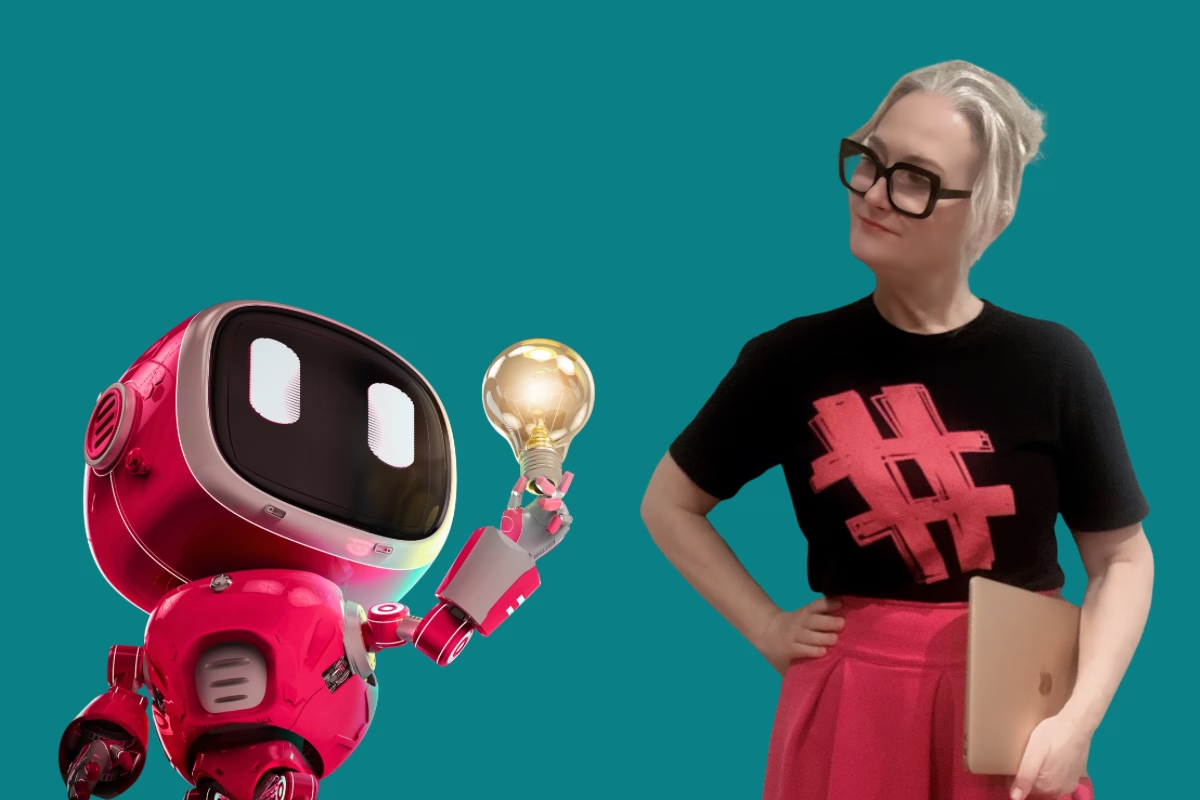
For months, the professional world has been consumed by one question: “Is AI coming for my job?” As someone who uses and trains people on Microsoft Copilot every day, I’ve seen the reality firsthand. The answer, it turns out, is far more interesting than a simple “yes” or “no.”
A groundbreaking study from Microsoft Research, “Working with AI,” recently confirmed what I’ve been seeing on the ground. After analysing over 200,000 real-world interactions with AI, the researchers painted a clear picture: AI isn’t replacing us. It’s augmenting us. It’s becoming our new professional partner.
But what does that mean for your career, right now? It means the definition of a high-value employee is changing. It’s no longer just about what you can do, but how effectively you can direct and collaborate with AI to amplify your work.
The Data: AI as a Collaborator, Not an Automator
First, let’s look at the evidence. The study revealed that the people using AI the most are “knowledge workers”—those of us whose jobs revolve around information, ideas and communication. The most common uses fall into three key pillars:
- Gathering and processing information.
- Writing and editing content.
- Communicating with others.
This is the core of modern office work and it’s where AI excels as an assistant. For example, I now regularly use Copilot to summarise long email threads to grasp key decisions instantly, or analyse meeting transcripts to pinpoint unassigned deliverables. This isn’t replacing my strategic thinking; it’s clearing away the administrative fog so I can think more clearly.
One of the most fascinating findings was the distinction between a “user goal” (what you want to achieve) and an “AI action” (what the AI does to help). In 40% of cases, these were different. This is the essence of collaboration. My goal might be to build a metadata schema, but the AI’s action is to assess documents and propose a structure. I provide the intent; it provides the initial analysis. I’m the architect; the AI is the surveyor.
Beyond the Study: A Framework for Your Future
Knowing that AI is a collaborator is one thing. Becoming a great collaborator is another. This requires a deliberate shift in how we approach our work. I believe it comes down to a three-part framework: Mindset, Skillset, and Toolset.
1. The Mindset: From Threat to Teammate
The single biggest barrier to leveraging AI is fear. The narrative of “job replacement” causes us to view AI with suspicion. The first and most critical step is to consciously shift this mindset.
Stop thinking of AI as a competitor. Start thinking of it as a new junior member of your team. It’s an incredibly fast, knowledgeable intern who has read the entire internet but has zero real-world experience. It can draft, research and summarise at lightning speed, but it lacks context, wisdom and strategic understanding.
Your role is to be the manager, the director, the strategist. You delegate the “first draft” and the “heavy lifting” to your AI partner, freeing up your own time and mental energy for the high-value work that only you can do.
2. The Skillset: What Makes You Irreplaceable
As AI handles more of the “what,” our value shifts to the “how” and the “why.” The skills that are becoming most valuable are not the ones that can be automated, but the uniquely human skills that AI complements. You need to focus on cultivating:
- Critical Thinking: The ability to evaluate the AI’s output. Is it accurate? Is it biased? What’s missing? Your judgment is more valuable than ever.
- Strategic Questioning (Prompt Engineering): Knowing how to ask the right questions to get the most valuable output. The quality of the AI’s answer is directly proportional to the quality of your prompt. This is the new art of delegation.
- Creative Synthesis: Taking the raw material the AI provides and combining it with your own ideas, insights and experience to create something new and valuable. AI can give you the building blocks, but you are the one who builds the vision.
- Emotional Intelligence: The ability to communicate, lead, empathise and build relationships. These skills remain firmly and perhaps permanently, in the human domain.
3. The Toolset: Moving from Theory to Practice
You cannot learn this by reading articles alone. You have to get hands-on. The final piece is to actively integrate AI into your daily workflows.
- Start Small: Don’t try to boil the ocean. Ask it to rephrase an email for a different audience or suggest a few headlines for a presentation.
- Draft the First Version: The blank page is often the biggest hurdle to productivity. Use AI to create the first draft of that report, project plan, or marketing copy. Your job becomes to edit and refine, which is often much faster.
- Become an Information Master: Use AI to summarise long documents, articles, and meeting transcripts. Ask it, “What are the three key takeaways from this?” or “What are the main arguments against this proposal?”
The conclusion from the research is clear, and my experience confirms it: AI is not the end of knowledge work. It is the beginning of a new, more dynamic, and ultimately more human way of working. The future belongs not to those who can simply do a task, but to those who can skillfully orchestrate intelligence—both human and artificial—to achieve a goal.
This blog post is a summary and interpretation of the research paper “Working with AI: Measuring the Occupational Implications of Generative AI” by Tomlinson, K., Jaffe, S., Wang, W., Counts, S., & Suri, S. (2025), combined with my own professional experience in the field.

Hi, I’m Liza 👋
Microsoft MVP (SharePoint) • SharePoint Blogger • Information Architecture Specialist
I’ve been working with SharePoint for nearly two decades, across consulting and in-house roles, helping organisations design, clean up, and scale their Microsoft 365 environments. I now run one of the fastest-growing SharePoint blogs, sharing practical guidance based on real-world experience.
My focus is information architecture — the layer that determines whether search works, governance sticks, and tools like Copilot actually deliver value… or quietly make things worse.
Through Simply SharePoint, I share practical, real-world guidance on structuring libraries, designing metadata, managing permissions, and fixing the issues that policies and “best practice” slides never really solve.
Everything on this SharePoint blog is based on how SharePoint is actually used — not how we wish it was used — with a strong emphasis on foundations that scale and hold up in the AI era.
