
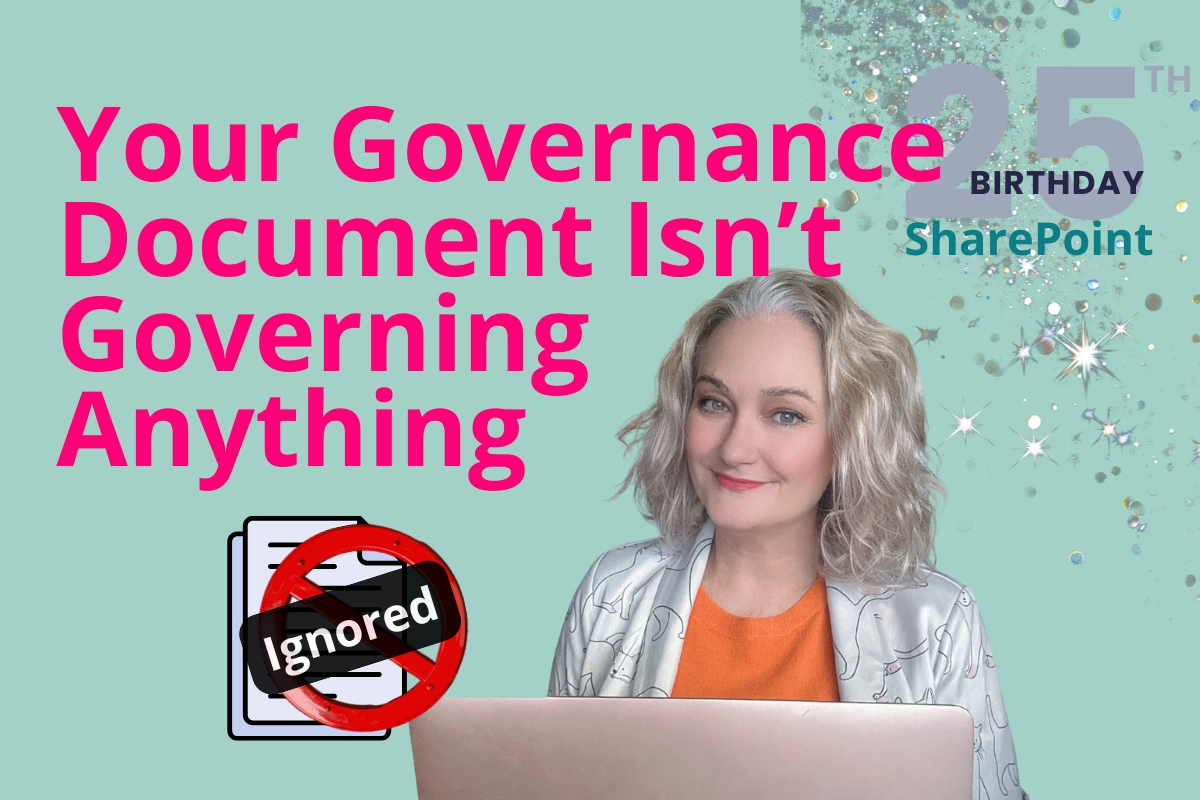
SharePoint 25th Birthday Series — Post 2
This year marks 25 years of SharePoint. Over that time, the platform has evolved from simple document storage into a critical foundation for collaboration, information management, and now AI-driven work.
What hasn’t evolved at the same pace is how we approach governance.
I’ll be upfront — I’ve never enjoyed writing governance documents. Not because governance isn’t important, but because writing long, theoretical policies that no one actually uses has always felt disconnected from the real work. Over the years, I’ve spent many hours carefully crafting governance documentation, knowing full well that once it was approved and uploaded, it would have very little influence on what people did day to day.
That experience isn’t unique to me. Across every version of SharePoint — from early on-premises deployments, through the subsite era, and into modern SharePoint and Microsoft 365 — governance has consistently been treated as a document. Something created during a project, signed off, stored in SharePoint, and quietly forgotten once the environment goes live.
The result is familiar to anyone who has supported SharePoint over time: inconsistent site structures, uncontrolled growth, fragile permissions, duplicated content, and environments that slowly drift away from their original intent. Now, with AI and tools like Microsoft Copilot relying on structured, trustworthy information, those issues are no longer just inconvenient — they directly affect outcomes.
If governance still lives outside the system, it isn’t doing its job.
The Problem with “Having a Governance Document”
Most organisations believe they have governance because they can point to a policy or framework. In practice, that document rarely shapes how SharePoint is actually used.
Governance documents tend to fail because they:
- Rely on users reading and remembering rules
- Assume people will make consistent decisions under pressure
- Expect training to compensate for poor structure
- Are written once while the environment continues to evolve
The intention is usually good, but the execution is flawed. People are not deliberately ignoring governance. They are simply working within the boundaries — or lack of boundaries — of the system they’ve been given.
When governance depends on people stopping to think, “What does the policy say?”, it is already disconnected from reality.
Governance Is a Design Problem, Not a Documentation Problem
Effective governance does not start with documentation. It starts with design.
Governance is a series of deliberate decisions about how the system behaves. Every choice you make about structure, permissions, metadata, and templates either reinforces good practice or quietly allows chaos to creep in.
Governance as a design decision shows up in areas such as:
- Defining which site types are allowed and when they should be used
- Standardising what a project, team, or department site looks like
- Deciding what metadata is mandatory, optional, or unnecessary
- Controlling who can create sites and how they are provisioned
- Applying permissions by default rather than relying on manual setup
- Building lifecycle and retention rules into libraries from the start
When these decisions are embedded into the environment, governance becomes part of everyday work rather than something people have to remember.
Where Governance Actually Lives in SharePoint
In a well-designed SharePoint environment, governance is not found in a folder full of policies. It is visible in the structure of the platform itself.
You see governance in:
- Site templates that provide consistency from day one
- Content types that define how information behaves
- Library defaults that reduce setup time and mistakes
- Views that replace fragile folder structures
- Permission models that are simple, predictable, and repeatable
- Automated lifecycle rules that do not rely on reminders or follow-up
This approach removes guesswork. Users don’t need to interpret governance — they experience it through the system.
The Goal Is Invisible Governance
The most effective governance is almost invisible to end users.
When governance is built into the design:
- Users are guided toward the right behaviour automatically
- Accidental mistakes are harder to make
- Consistency scales without constant oversight
- Support and maintenance become significantly easier
If governance only becomes visible when something goes wrong, it is reactive. If it quietly prevents problems before they occur, it is doing exactly what it should.
Why This Matters Even More with Copilot
This shift becomes critical as organisations move toward AI-enabled work.
Microsoft Copilot does not read governance documents.
SharePoint does not infer intent from messy structures.
Microsoft AI tools can only work with what the system understands.
Poor information architecture, inconsistent metadata, and unclear ownership do not just frustrate users — they directly undermine AI outcomes. Without governance built into the design, AI simply amplifies existing problems instead of solving them.
This is why governance and information architecture cannot be separated. There is no AI without structure, and there is no structure without governance by design.
Better Questions to Ask About Governance
Instead of asking whether a governance document exists, more useful questions include:
- Does the design guide users toward the right decisions?
- Are users prevented from accidentally doing the wrong thing?
- Is consistency enforced through templates rather than training?
- Would this environment still work if no one read a policy?
If the answer to these questions is yes, governance is working — regardless of whether a document exists.
Final Thoughts
Governance is not something you complete and file away. It is not a deliverable, and it is not a policy sitting in SharePoint.
It is an ongoing set of design decisions that shape how information is created, stored, shared, and managed every day. As SharePoint enters its next 25 years — and as AI becomes embedded in how we work — governance has to move out of documents and into design.
If you want better SharePoint, better collaboration, and better AI outcomes, the answer is not more governance paperwork.
It is better system design.
Ready to make SharePoint simpler?
Explore the Simply SharePoint Hub
If this post helped you untangle part of SharePoint, you’ll find more practical guides, templates, toolkits and resources inside the Simply SharePoint Hub. It’s where I keep the downloads and support materials designed to help you clean up, structure and actually use SharePoint with more confidence.
Visit the Simply SharePoint Hub →
Hi, I’m Liza 👋
Microsoft MVP (SharePoint) • Information Architecture Specialist
I’ve been working with SharePoint for nearly two decades, across consulting and in-house roles, helping organisations design, clean up, and scale their Microsoft 365 environments.
My focus is information architecture — the layer that determines whether search works, governance sticks, and tools like Copilot actually deliver value… or quietly make things worse.
Through Simply SharePoint, I share practical, real-world guidance on structuring libraries, designing metadata, managing permissions, and fixing the issues that policies and “best practice” slides never really solve.
Everything here is based on how SharePoint is actually used — not how we wish it was used — with a strong emphasis on foundations that scale and hold up in the AI era.